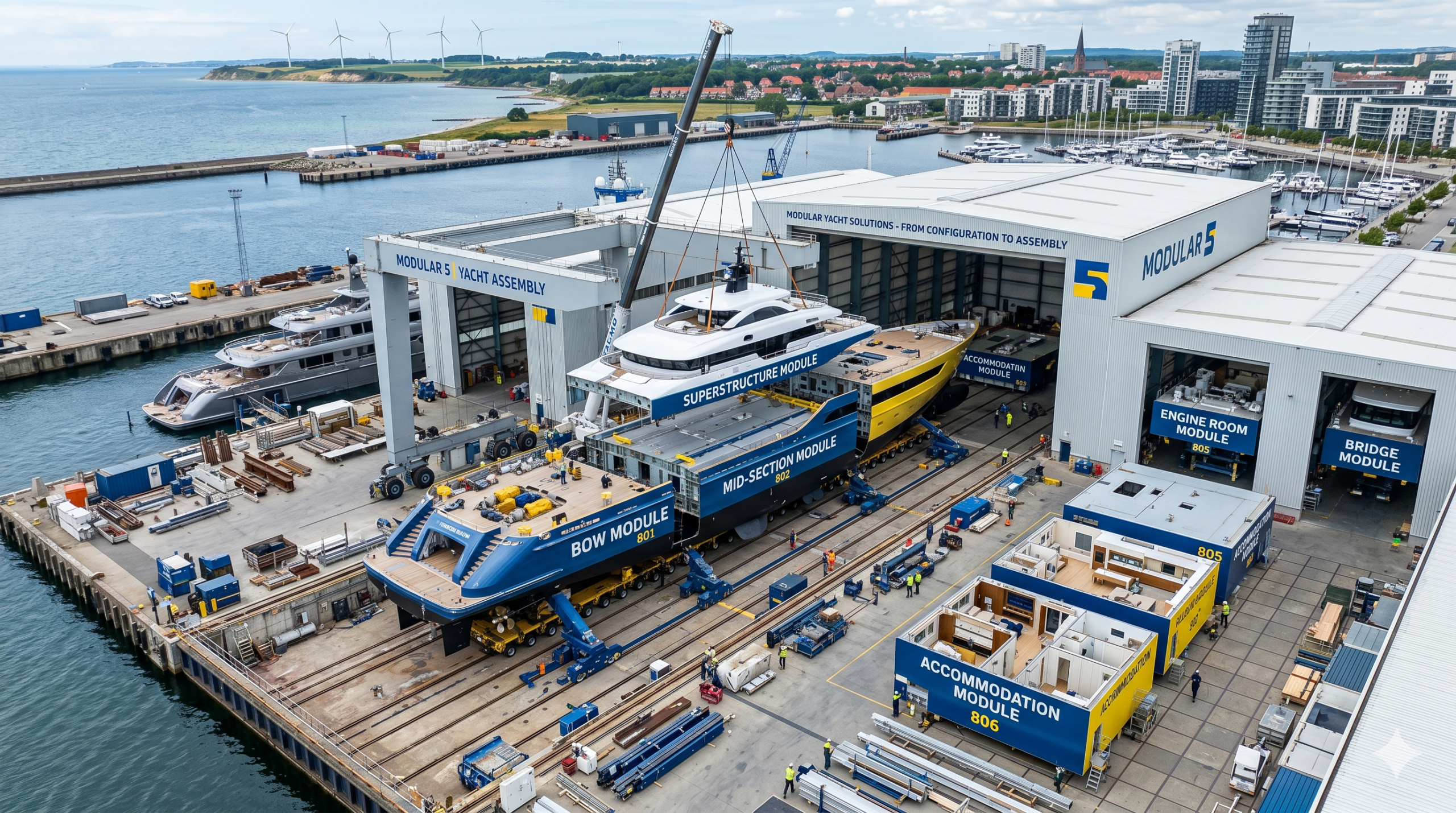
Our Approach
Intro
The transition from Engineer-to-Order (ETO) to Configure-to-Order (CTO) is not an IT project and not a pure engineering question either. It’s an integral change that touches product architecture, processes, governance and product data.
MODULAR5 makes this transition tangible by combining consultancy and engineering: we don’t just design the solution, we also build it into your product structures and systems.
Change management & stakeholders
A CTO transformation requires behavioural change and new rules. That’s why we actively guide change management and work according to learning by doing: teams directly see how the new structure looks and how it works.
We involve the most important stakeholders from day one:
- Leadership / MT — executive sponsorship and decision-making
- Sales and sales engineering — customer choices and configurable offer
- Engineering — architecture and realisation
- Operations and manufacturing engineering — manufacturability and industrialisation
- Supply chain and procurement — standardization and sourcing
- Service — lifecycle, upgrades, maintainability
- IT / PLM owners — data governance and integration
- Product management — platform ownership and roadmap
Questions worth asking before you change anything.
Honest answers about modularization, costs, timelines, and what changes when you work with us.
FUNDAMENTALS
What is modularization in manufacturing?
Modularization means designing products from standardized building blocks (modules) with fixed interfaces, instead of starting from scratch on every order. You offer customers variation while reusing 80% of your design and production work. Think LEGO — for industrial products.
What is the Engineering-To-Order (ETO) and Configure-To-Order (CTO)?
In ETO, every order triggers a custom engineering project — high effort, long lead times. In CTO, orders are configured from pre-engineered modules — shorter lead times, lower cost, predictable margins. MODULAR5 guides you from one to the other without losing the ability to offer real customization.
Is modularization right for our company?
If you build complex products in low-to-medium volumes, face engineering bottlenecks, and lose deals to long lead times — yes. If you build truly one-of-a-kind systems where every order is fundamentally different, the picture is more nuanced. Our four-week Scan tells you whether the business case stands up before you commit to anything.
We already standardized parts. How is modularization different?
The key difference is the balance between efficiency and flexibility.
Standardization reduces choice. You cut the number of options at component, subassembly and end-product level. The result is often a “take it or leave it” offer, where flexibility and customer-specific features are stripped out to make management easier.
Modularization also reduces unique parts (bolts, conveyor widths, and so on), but captures them in smart, functional modules. Instead of limiting choice, those modules let you assemble a diverse portfolio of end solutions — a “smart tailored suit”: the customer gets exactly what they need, while you benefit from fewer unique parts.
The difference in short:
- Flexibility: standardization narrows variation; modularization lets a limited set of building blocks (e.g. 1,000 modules) produce millions of end configurations.
- Architecture: modularization uses a LEGO mindset with fixed interfaces, so new functions or machines simply click together.
- Customer value: modularity doesn’t restrict you — it makes you more flexible, faster, better-priced and higher-quality.
It’s exactly how you grow from Engineering-To-Order (ETO) to Configure-To-Order (CTO) without losing control of complexity.
What is the difference between products and systems?
It comes down to coherence, complexity and how things connect.
Products (standalone machines): individual units that stand on their own. A single product can already be complex through options and variants — a bicycle with just five options can have more than 5,500 variants. The focus is on engineering the specific functions of that one machine.
Systems (line solutions): created when multiple machines are connected into one integral solution, such as a full production line. Here it’s not just about the individual machines, but about how they function as one whole, driven by the same control system.
The main differences:
- Interdependence: in a system the parts depend on each other. The output of one product (e.g. the speed of an infeed conveyor) directly affects the next product in the line (a weighing or packaging machine).
- Architecture and interfaces: systems need a solid architecture with fixed interfaces. Without them, separate products have to be “welded” together afterwards by engineering, which means slow custom work. In a modular system, machines simply click together.
- Complexity of the logic: the number of rules to configure a system line is far greater than for a single product. Where a product can have thousands of variants, a system configuration quickly runs into millions of possibilities through the sum of dependencies.
Our advice: start at the base. Make the individual modules or machines (the products) configurable first, then connect them at system level.
What are the three pillars for moving from ETO to CTO?
Three pillars have to be in place to make the transition from Engineering-To-Order to Configure-To-Order succeed:
- Product architecture: the product is broken down into logical, modular function blocks, modules and parts. The goal is an architecture with clear interfaces, so new functions can be “clicked on” like LEGO.
- Organizational maturity and processes: define who owns what within the modular structure (product owner, system owner, configuration owner). The organization needs training, and the new way of working needs to be captured in processes.
- Digitalization: the software that manages variation and product data, such as CPQ (Configure, Price, Quote) and PLM (Product Lifecycle Management).
These three pillars must stay in balance. A common pitfall is investing in a digital tool (like a CPQ solution) while the product architecture or internal processes aren’t ready yet — which is exactly where implementations stall.
CONCERNS & OBJECTIONS
Won’t modularization limit what we can offer to customers.
The opposite. Configuring from modules typically multiplies your offerable end products by 10× or more — without adding complexity behind the scenes. We follow the 80/20 rule: 80% of orders use pre-engineered modules, 20% gets late-stage customization. Customers experience more choice, not less.
Our products are too custom for modularization.
We hear this from almost every client we work with. In nearly every case there’s significant modularization potential hiding under the surface. The Scan tells you where it makes sense and where it doesn’t — Engineer-to-Order remains a valid mode for the truly unique 10%.
What does it cost?
A modularization journey is an investment, not a fixed fee. We start with a four-week Scan (fixed scope, fixed price) to determine the business case. Pilots typically run two months, full portfolio rollouts six to twelve months. By splitting strategic work in the Netherlands from execution in our India team, we keep the total cost competitive.
Won’t our engineers resist this change?
Sometimes. Modularization frees engineers from repetitive order-engineering and lets them focus on innovation — which most senior engineers appreciate once they see it in practice. We address resistance directly through cross-functional workshops and learning-by-doing, before any structural change lands.
THE MODULAR5 PROCESS
How does MODULAR5 engage with a new client?
We start with a Scan — a four-week diagnostic covering product, processes, organization, and digital backbone. We identify where you’re leaking value and where modularization is realistic. From there we propose a pilot. We don’t deliver PowerPoints — we build capability inside your team.
What is ‘Smart Customization’?
Smart Customization is our core philosophy: offer customers exactly the variation that adds value to them, and standardize ruthlessly everywhere else. The opposite of mass customization (which often becomes mass complexity), Smart Customization keeps custom work tightly contained to the late stage where it actually matters.
How is MODULAR5 different from a traditional consultancy?
Most consultancies stop at strategy and PowerPoints. We do both the thinking — architecture, principles, roadmap, done in the Netherlands with you — and the doing — CAD work, classification, master models, executed by our dedicated team in India. Strategy without execution is just a hallucination.
Which roles do you need to work Configure-To-Order?
Moving from ETO to CTO requires a few clearly defined roles and responsibilities:
- Product, System and Module owners: responsible for the modular structure and the content of the different parts of the portfolio.
- Configuration owner: guards the logic and coherence inside the product configurator.
- Product Manager: the crucial link — the “referee” between commercial (market demand) and engineering (the technical detail). The product manager keeps the balance between what the market wants and what’s modularly feasible.
- Commercial Manager / Director: determines market demand (what the market asks, not just one specific customer) and manages the sales BOM.
- Product Change Manager and Change Board: essential for release management. They make sure changes are rolled out in a structured way across all systems (CAD, ERP, configurator).
- Management: the move to CTO has to be carried and steered from the top, because it fundamentally changes the company’s “rules of the game”.
In smaller SMEs these don’t have to be separate job titles, but the roles do need to be clearly assigned to the right people — otherwise the process stalls.
PRACTICAL
Why do you have an engineering team in India?
The India team handles the execution and implementation of modularization projects — especially when companies stall after a successful pilot because of the sheer volume of data work.
- Capacity and scalability: a pilot of 500 items can often be done in-house, but a full portfolio easily runs to 20,000 items. Most companies don’t have the time or people to take that on alongside regular projects.
- Specialist knowledge: our India engineers are trained specifically to think in the “master model architecture” — working with options, variants, CAD models, part classifications and building product models in CPQ or PLM systems.
- Separating thinking from doing: the strategic part (“the thinking”) happens with you in the Netherlands; the execution (“the doing”) happens in India.
- Cost efficiency: putting the execution in India lets us offer it at a sharp hourly rate, which lowers the barrier to making your full portfolio modular.
In short: India is the engine that keeps the wheel turning, so the transition from ETO to CTO doesn’t stall on a lack of time or specialist data experience inside your own team.
Do you provide software like CPQ or PLM?
No. We’re vendor-agnostic — we work with whichever CPQ, PLM, and ERP systems fit your situation best. What we bring is the modular architecture and data model that makes those systems actually deliver value.
How long does a full modularization journey take?
First measurable impact appears within six months, after a pilot. A full portfolio rollout typically runs 12–18 months. Connecting individual machines into configurable production lines is usually a year-two ambition. We never push for big-bang transformations — adoption beats speed.
How do you determine the right size of a module?
There’s no fixed formula — it’s a constant trade-off and a compromise between departments. But there are clear guidelines and pitfalls.
- Balance between variation and maintenance
- When to make it smaller: if too many unique variants or options land on one module, the model gets too complex. Then it’s wise to push the module “a layer down” and make it smaller.
- The danger of modules that are too small: tiny “LEGO bricks” drive up the maintenance load enormously. You get technical perfection, but the solution becomes too expensive and unmanageable.
- Different perspectives within the organization
- Sales: wants modules as large as possible (e.g. just a “front” and a “back” of a machine) for easy quoting.
- Engineering: wants to avoid complexity. Left to engineering alone, modules tend toward small, technically perfect blocks — which makes the solution costly.
- Service: looks at replaceability. They might want a motor as its own module, because that makes overhauling or swapping in the field easier.
- Production: looks at the interface and how easily modules can be assembled.
- Strategic factors
- Function: what specific task does the module need to perform?
- Interface: which fixed connection points are defined? This determines where a module starts and ends.
- Market demand: how many of the 1,000 possible market questions can you capture in, say, just five to seven smart modules?
In short: get a cross-section of every department at the table to decide together what size works best for sales, production and service alike.
Do you offer training?
Yes. Our 3-day Modular Design training (max 12 participants) gives engineers and product managers hands-on capability using your own products as case material. A 1-day management variant helps leadership understand and steer the transformation.
Still have a question?
Book a 15-min scan call. We’ll listen, ask sharp questions, and tell you within a week whether modular thinking fits your situation.
What is your futureIndustry?

Modular Machine Building

Modular Trailer Engineering